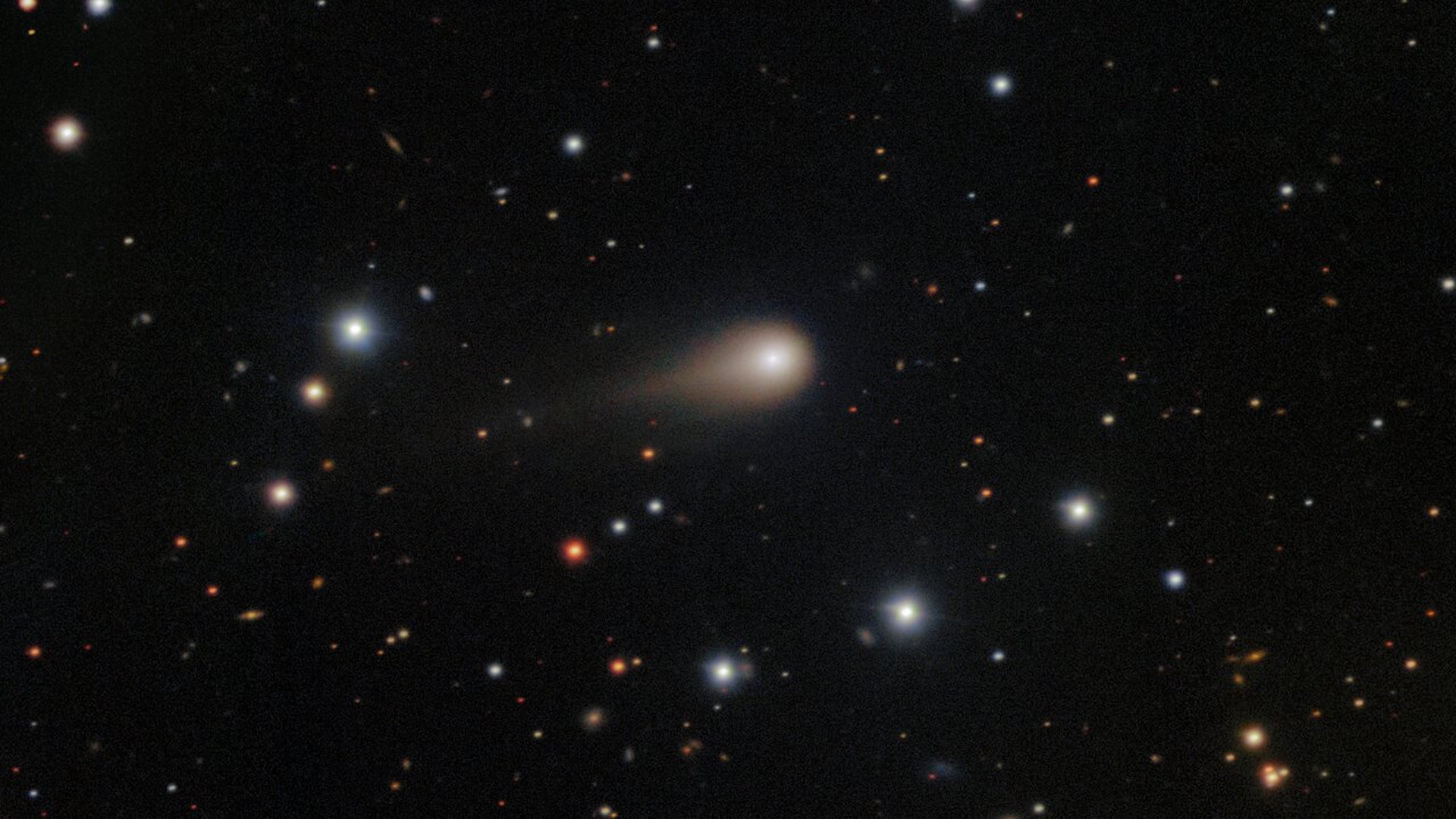
New images of the interstellar comet 3I/ATLAS nearing Earth have been captured by astronomers
New insights into comet 3I/ATLAS highlight its distinctive composition and active tails as it approaches its nearest point to Earth this month. The interstellar traveler, hailing from outside our solar system, has captivated scientists’ attention since it was first identified in July 2025.
Comet 3I/ATLAS represents just the third interstellar object identified as it journeys through our solar system, rendering each observation vital for comprehending its path, makeup, and actions. Detailed images of the comet have been captured by both the Hubble Space Telescope and the European Space Agency’s Jupiter Icy Moons Explorer (Juice) mission, providing unparalleled insight into this extraordinary cosmic event.
The comet’s teardrop-shaped coma is unveiled by Hubble
Hubble first observed 3I/ATLAS shortly after its discovery in July 2025, when the comet was roughly 277 million miles from Earth. Using its Wide Field Camera 3, Hubble documented a distinctive teardrop-shaped halo of dust extending from the comet’s icy nucleus. This glowing cocoon of material highlights the ongoing sublimation of gases and particles as the comet warmed while approaching the sun.
Observations persisted on November 30, when the comet was 178 million miles (286 million kilometers) away from Earth. Hubble obtained even more precise images, enabling astronomers to examine the comet’s changing form and gas emissions with increased detail. These images are crucial for monitoring the comet’s trajectory and comprehending how interstellar objects react when subjected to the sun’s energy.
Juice spacecraft captures dual tails
While Juice’s primary mission is to study Jupiter and its largest moons—Ganymede, Callisto, and Europa, which may host subsurface oceans capable of supporting life—it took advantage of its trajectory to observe comet 3I/ATLAS in early November. From a distance of about 41 million miles (66 million kilometers), the spacecraft used five scientific instruments and its onboard Navigation Camera (NavCam) to record the comet’s activity.
The spacecraft sent a segment of the NavCam data prior to the complete download timeline. The images display a luminous coma surrounding the comet, accompanied by two separate tails: a plasma tail made up of electrically charged gases and a more subtle dust tail composed of solid particles. This dual-tail formation is typical of comets in our solar system; however, witnessing it on an interstellar object offers valuable insights into its physical and chemical characteristics.
Juice’s comprehensive dataset, anticipated to reach Earth between February 18 and 20, will encompass high-resolution images, composition analysis, and particle measurements. This information might illuminate the comet’s origin and the environment it traversed before entering our solar system.
Proximity to Earth and Observability
Comet 3I/ATLAS is anticipated to come within 167 million miles (270 million kilometers) of Earth on December 19, situating it on the far side of the sun and presenting no danger to our planet. To put this in perspective, Earth orbits at approximately 93 million miles (150 million kilometers) from the sun, underscoring that the comet will stay safely remote while remaining visible to telescopes and space missions.
Even after its closest approach, the comet is expected to remain visible for several months as it continues its journey out of the solar system. Observations during this period will allow scientists to monitor how the comet interacts with solar radiation and the solar wind, further contributing to our understanding of interstellar bodies.
Insights into interstellar origins
Studying 3I/ATLAS offers a unique glimpse into material that originated beyond our solar system. The comet’s icy nucleus, surrounded by a cloud of dust and gas, might hold insights into the chemical composition of remote star systems. The tails, influenced by heat and solar radiation, enable scientists to explore how volatile compounds behave when subjected to the sun.
Every interstellar traveler offers distinct chances to contrast the formation of our solar system with that of other stellar systems. By examining the composition of 3I/ATLAS, researchers aim to reveal insights into the kinds of materials present in different regions of the galaxy and their evolution over time.
Future observations and research potential
The information gathered by Hubble and Juice constitutes just a fraction of the possible insights this comet might offer. Future observations from both terrestrial and space telescopes will assist in monitoring the comet’s path, assessing its changes in brightness, and enhancing models of its course.
As more data arrive from Juice, researchers anticipate learning more about the distribution of dust and gas in the coma and tails, the size and rotation of the comet’s nucleus, and potential isotopic signatures that could reveal the interstellar environment from which it originated. Such findings could enhance our understanding of planetary formation, interstellar chemistry, and the prevalence of comets traveling between star systems.
The singular chance offered by 3I/ATLAS highlights the significance of synchronized observations from various space missions. By merging high-resolution imaging from Hubble with in-situ data from Juice, researchers are able to construct a detailed depiction of an object that has journeyed through the galaxy to arrive at our solar system.
In conclusion, comet 3I/ATLAS offers an extraordinary glimpse into the wider universe beyond our solar system. Its teardrop-shaped coma, dual tails, and interstellar origins provide invaluable data for astronomers, while its safe approach allows continued observation from Earth. The ongoing analysis of images and measurements from Hubble and the Juice spacecraft promises to deepen our understanding of how interstellar objects behave, paving the way for future discoveries about the cosmos.